Using a Cross-Institutional Collaborative Model to Deliver a National Roundtable Conference on Assessment: A Case Study
Natalie Brown
University of Tasmania
Natalie.Brown@utas.edu.au
John Littrich
University of Wollongong
littrich@uow.edu.au
Abstract
This paper describes the organisation, preparation and delivery of a major project, namely, a national roundtable conference on assessment, in the context of a wider project involving the development and application of a model of collaboration between tertiary institutions based on a distributive leadership framework. It analyses feedback received from round table participants and comments on both the utility and the limitations of the adopted model for the purpose of the round table project.
Introduction
Recent years have seen increased interest in the scholarship of university teaching and learning both in Australia and internationally (Kreber 2007; Trigwell, Martin, Benjamin & Prosser 2000). This reflects not only a desire on the part of teachers to better understand and document their teaching and its effectiveness as a process of professional development, but also the greater pressure faced by institutions in relation to quality assurance (Kreber 2007). In Australia, the review of university teaching and emphasis on greater accountability via the Australian University Qualities Agency (AUQA), the recently shelved Research Quality Framework (RQF) and the availability of funding for research in this area from sources such as the Carrick Institute for Learning and Teaching in Higher Education (recently renamed the Australian Learning and Teaching Council) have all provided incentive for research in this field. 1
In 2006, a project team led by Dr Geraldine Lefoe of the University of Wollongong (UOW), targeting a specific focus of part of the Carrick Institute's grant scheme, namely, 'Leadership for Excellence in Learning and Teaching', successfully applied for funding for a major project. Titled Distributive Leadership for Learning and Teaching: Developing the Faculty Scholar Model, the project aimed to expand an existing faculty learning and teaching scholars program already established in two universities "to include the development of leadership capacity via cross institutional consultation and collaboration whilst maintaining the importance of the use of authentic projects as vehicles for change" (Lefoe, Smigiel & Parrish, 2007, p. 2)2. For the purpose of this paper, this project will be referred to as 'the Leadership Project'. The project team chose to use the concept of 'distributive leadership' as a framework for the Leadership Project. This concept is discussed in the next section of this paper.
Stage one of the Leadership Project involved the teaming of six 'faculty scholars' from the University of Wollongong (UOW) working on projects relating to assessment with six similarly engaged 'assessment fellows' from the University of Tasmania (UTAS). The group was led and supported by a project team. The scholars and fellows were each advised that, in addition to their individual projects, part of their role as scholar or fellow was their participation in the Leadership Project. Each institution provided a senior support person and a facilitator from that institution's academic development unit (Lefoe, Smigiel & Parrish, 2007, p. 3). The authors of this paper were part of the scholars and fellows group.
Stage two of the Leadership Project is currently underway and involves what the project team describe as the 'cascading' of the cross institutional collaborative model into two new partner universities in 2008 with stage one participants supporting and facilitating this process, mentoring new participants and sharing knowledge and skills acquired in stage one. The project team have indicated that if the model is successful, it will cascade into further institutions (Lefoe, Smigiel & Parrish, 2007, p. 4).
One of the Leadership Projects' deliverables was identified as the planning and staging of a national roundtable conference3 on current issues in assessment (the 'roundtable project') drawing on the individual projects of the scholars and fellows. It is this project that forms the subject of the case study in this paper. This paper examines feedback received from participants (the scholars and fellows as well as invited participants) in the roundtable project. It examines that information against distributive leadership principles to evaluate the success of the round table project as a vehicle for the provision of opportunities for the scholars and fellows to develop and practice distributive leadership and evaluates the success of the roundtable project framework as a model for cross-institutional collaboration.
Distributive Leadership and the Roundtable Project: A Brief Overview
A detailed discussion of the concept, 'distributive leadership', is beyond the scope of this paper but it is necessary to give an overview of the concept in order to understand the basis of the model adopted for the Leadership Project and the authors' findings. Distributive leadership is not a new concept and has been a subject of discussion in educational circles for some time, particularly in the context of primary and secondary school education (Gronn, 2002; Gronn, 2003; West-Burnham, 2004; Spillane, 2006) where the similar term, 'distributed leadership', is also often used. With distributive leadership, the concept of leadership in a school context is viewed less as the responsibility of a single 'heroic leader' and more "as a function of the school as a whole" (Whitby, 2006, p.2; Gronn, 2002). A recurring theme is the link between effective leadership and good teaching and learning practice (Whitby, 2006).
'Distributive leadership' has no single definitive expression (Bennett, Wise, Woods & Harvey, 2003; Zepke, 2007). The lack of a single definition of 'distributive leadership' makes it difficult to gain a clear understanding of the concept but its characteristics have been said to include collaboration rather than hierarchical structure; a shared purpose; shared accountability and responsibility; and the building of leadership capacity amongst the members of a group or organisation (Marshall, 2006; West-Burnham, 2004). Part of the difficulty in pinning the concept down to an exact definition is that rather than being a definite theory, distributive leadership is a style or practice of leadership (Spillane, 2006). As noted earlier, a lot of the school-based research also utilises the term 'distributed leadership'. This perhaps adds to further difficulty since, while "'good' and/or 'effective' leadership is almost universally recognized, its nature remains elusive" (Marshall, 2006).
The project team maintain the concept of distributive leadership has useful application to leadership for learning and teaching in higher education, arguing that traditional, hierarchical leadership structures are ill-designed to meet the challenges facing universities in the 21st Century (Lefoe, Smigiel & Parrish, 2007, p. 2). They see the collaborative, group responsibility nature of distributive leadership as allowing for the development of leadership capacity across a department, school or institution rather then placing reliance on a single leader, thereby better equipping that department school or institution to cope with change.
The project team began by setting out its own definition of distributive leadership for the purpose of the Leadership Project. Distributive leadership was defined as "a distribution of power within the sociocultural context of the universities and a sharing of knowledge, of practice and reflection through collegiality" (Lefoe, Smigiel & Parrish, 2007, p. 2). The project team also highlighted four key factors identified by West-Burnham (2004) which they saw the Leadership Project as providing "opportunities to address" (Lefoe, Smigiel & Parrish, 2007, p. 2). They were: "building trust; redesigning jobs; changing organisational structures; and creating a learning culture" (West-Burnham 2004, p. 2 cited in Lefoe, Smigiel & Parrish, 2007, p. 2).
Rather than apply the chosen framework to a new model or program, the project team applied a distributive leadership framework to expand and develop the existing faculty scholar/assessment fellow model at UOW and UTAS. The faculty scholars or fellows were already engaged in projects aimed at improving learning and teaching. In explaining the background to the Leadership Project and its objectives, the project team point out (Lefoe, Smigiel & Parrish, 2007, p. 3) various reported instances in the literature of the development of leadership in teaching and learning through authentic learning tasks under a faculty scholar model and the use of frameworks with similar principles (such as the 'community of practice' framework) to support and develop leadership in teaching but argue that there is a gap in the literature in relation to the application of a distributive leadership framework to such a model. The Leadership Project appears to have been designed to address that gap.
The cross-institutional and 'cascading' aspects of the Leadership Project would appear to align with factors identified by the project leaders as characteristics of distributive leadership such as the building of trust, the creation of a learning culture and the sharing and dissemination of information. The inter-faculty and cross-institutional aspects of the Leadership Project also appear to address another area of increasing interest in teaching research. Tight, writing in the UK in 2003 (p. 185), identified "studies of academics working together in departments or institutions, focusing on their collective experience and inter-relationships" as an area for further research in Higher Education. In the same year, Jenkins, Breen and Lindsay (2003), in their review of UK universities, highlight some examples of collaborations, both national and international, designed to strengthen the teaching-research nexus. The projects they highlight primarily involve avenues for raising awareness of practice, in particular through conferences and publication opportunities as well as informal alliances to share strategies and case studies. The authors go on to promote the extension of these activities as a means to help reshape teaching in higher education. The Leadership Project and the roundtable project within it would appear to be such an extension.
The Roundtable Project: The Planning Process
In early 2007, the scholars and fellows began meeting in their respective institutions, discussing their individual projects and building relationships with their institutional colleagues and project team. The individual projects of the scholars and fellows were diverse and included the development of national criteria for the assessment of woodwind performance; developing assessment in a 'creative curriculum' for journalism students and; the synthesis of graduate qualities and assessment across a Bachelor of Laws curriculum. The common link in all projects was assessment. The level of interest in assessment at a school, faculty and institutional level in the two participating institutions is not surprising given the widely recognised crucial relationship between learning and assessment (Boud, 2007; Nichol 2007). Indeed, it has been said that assessment drives learning (Albon, 2003; Ramsden, 1992).
In March, 2007, the scholars, fellows and project team participated in a three day residential leadership program designed to serve a number of purposes: the development of relationships between the participants; a forum for discussion, feedback, reflection and evaluation of scholars/fellows' assessment projects; leadership training; and, initial planning for the roundtable project. Lefoe, Smigiel & Parrish 2007, p. 4). The scholars and fellows participated in information and discussion sessions as well as various workshop activities aimed at familiarising participants with the concept of distributive leadership. From these sessions, the group created eight draft guiding principles for practicing distributive leadership, holding that distributive leadership: 1) generates engagement; 2) acknowledges and recognizes leadership irrespective of position; 3) focuses on people's strengths; 4) is different things in different contexts; 5) is enduring; 6) requires the development of strong relationships and networks; 7) is about capacity building and development; and 8) assists and informs succession planning.
The scholars and fellows were encouraged to consider synergies between the various projects and possible collaborative opportunities. After the residential program, the scholars and fellows continued to work on their respective projects and met formally and informally in their respective institutions pursuant to a schedule. These meetings posed logistical difficulties for those not operating from a common campus. In addition to roundtable planning, the meetings provided opportunities for reporting, feedback and sharing of information in relation to individual projects as well as opportunities to reflect on the wider Leadership Project. A cross-institutional online collaborative space was set up. Participants were encouraged to use the space for group communication, progress reports and shared reflection. Other than this on-line communication, communication between the UOW scholars and the UTAS fellows was fairly limited until serious planning for the roundtable project began in June/July, 2007. A number of planning meetings were then held between the scholars and fellows via video conference and teleconference. These presented difficulties in terms of finding convenient times and venues as well as difficulties in being heard and understood.
A scholar/fellow from each institution agreed to take on a facilitative and administrative role for planning the roundtable project. Whilst group responsibility for the project was not thereby abrogated, these individuals took on a higher workload than the rest of the group. Over several meetings, the themes and format of the roundtable emerged via consensus. The group continued to explore the links between the individual projects and structured the roundtable presentations around those links and identified assessment principles. Consistent through all discussion was the central role of assessment and the notion of assessment as learning.
A planning meeting attended by all fellows and scholars participating in the roundtable (eleven out of the total group of twelve) on the day before the roundtable proved invaluable in finalising arrangements. It also presented a valuable opportunity for members to reconnect and strengthen relationships. For most of the group, it was the first face to face meeting with group members from their partner institution since the March residential program.
Methodology
This paper has taken a case study approach (Stake 1995; Yin 2003) in relation to the feedback data collected from the roundtable conference. This approach is widely employed in Higher Education research involving small scale projects that examine aspects of practice (Tight 2003). Consistent with a case study approach, the roundtable project concerned a single event – from the planning stage to its implementation. This conforms to Stake's description of a 'bounded system' that is 'complex' and 'dynamic' (Stake 1995). Two research questions were posed:
RQ1 |
How successful was the organisation and implementation of the Assessment roundtable in providing opportunities to develop and demonstrate distributive leadership? |
RQ2 |
Was the roundtable a successful example of cross-institutional collaboration? |
Although the findings of this paper are confined to a single case, it presents an example of how identified principles, in this case principles of distributive leadership could be used as a framework for evaluating a project or initiative. This project also provides insights into how a cross-institutional collaborative project can be planned, implemented and evaluated.
Data collection and analysis
A mixed methods approach (Creswell 2003), was employed using qualitative and quantitative data collected from multiple sources. There were three main data collection instruments:
- A portfolio of documents relating to the planning of the roundtable;
- A post-roundtable survey of scholars and fellows;
- A post-roundtable survey of invited participants.
- Reflective discussion with scholars/fellows a substantial period after the roundtable.
The documents comprising the portfolio included diaries of meeting dates, records of email contact, agendas and minutes of meetings, excerpts from the authors' reflective journals, newsletters, programs for the planning day prior to the roundtable and the program of the roundtable itself. It also included the list of invitees to the roundtable and the record of acceptances. In the informal discussion noted at iv above, the scholars and fellows were asked to identify any benefits they believed they had gained personally from the roundtable project and how useful they found the concept of distributive leadership both as a framework for the roundtable project and in their workplace afterwards.
To obtain an overall picture of the qualitative data from the organisational record, all documents were read through in their entirety prior to being summarised and collated to provide a picture of the organisation of the event, as suggested by Miles and Huberman (1994). Quantitative data was also extracted from the documentation in the form of descriptive statistics that assisted in clarifying aspects of the project.
The surveys were designed to gauge the success or otherwise of the roundtable in terms of meeting expectations of both the scholars and fellows group as well as the invitees. To allow comparison between stakeholder groups, the same questions were used on both survey forms. Surveys were distributed at the conclusion of the roundtable, and participation was voluntary. Data was collated by one of the scholars/fellows group who removed identifiers for the purpose of this analysis.
This survey instrument sought information on overall impression of the roundtable – measured through asking participants for a Likert scale response to four key statements. They were then asked to rate each session against a Likert scale. This provided quantitative data that provided useful descriptive statistics and measures that allowed some comparison between participant groups (scholars/fellows and invitees). Detailed statistical analysis was not performed due to the small numbers of participants in each group (nine and sixteen respectively).
Qualitative data was elicited from the surveys through the inclusion of four open ended questions. These questions asked participants what they found to be most useful, where the roundtable could be improved and whether they would consider future collaborations as a result of the roundtable. The final question invited any further comments. The open-ended responses were analysed through collation and categorisation to identify emerging themes Patton 1990). Eliciting both quantitative and qualitative data allowed a deeper understanding of participants' responses by 'going back and forth progressively clarifying the findings of one with those of another' (Sogurno, 2002).
Results and Discussion
The Roundtable Project: Evaluation of the Assessment Roundtable
The theme developed by the group for the roundtable was Assessing student learning: Using interdisciplinary synergies to develop good teaching and assessment practice. As suggested by the title, the group hoped to stimulate discussion on current issues in assessment and create strategies for dealing with these issues and the promotion of good teaching and assessment practice.
The roundtable took place in Sydney in September, 2007. A total of 44 persons attended. Of these, 11 were scholars/fellows and a further four were involved in the project as coordinator, manager, evaluator or administrative support. The 29 invitees who attended included two directors of the Carrick Institute, members of the Leadership Project steering committee, representatives from the two universities who will be cascading partners, together with experts on assessment from all Australian states and two New Zealand universities. It should be noted that the roundtable took place during semester time. This prevented some invitees from attending and also prevented one of the fellows from attending due to overseas teaching commitments.
After a keynote presentation, each of the scholars/fellows who attended presented a précis of their project during a series of 10 minute presentations. The order for the presentations was determined by consensus through an effort to link the content of the presentations and provide connections for the audience. Eight of the group also elected to prepare a poster outlining their project for display in the foyer. The presentations were followed by a plenary discussion session, a session for small group discussion and a final plenary session looking at future directions in assessment. All members of the scholar/fellows group undertook roles during the roundtable; introducing sessions, directing activities, summarising feedback or facilitating discussions. In addition, scholar/fellows also performed administrative and housekeeping functions through the day, under the direction of one of the group.
At the conclusion of the roundtable, all participants were given a questionnaire to elicit feedback on the day. The first section invited overall comments against a series of four statements. Results are presented in Table 1.
Table 1: Assessment Roundtable Evaluation summary
| The roundtable met my expectations | Strongly agree |
Agree |
Neutral |
Disagree |
Strongly disagree |
|---|---|---|---|---|---|
Scholars/Fellows (n = 9) |
44% (4) |
56% (5) |
|||
Invitees (n = 16) |
38% (6) |
44% (7) |
13% (2) |
6% (1) |
|
The sessions were useful in facilitating discussion on a range of issues to do with assessment of learning in universities? |
Strongly agree |
Agree |
Neutral |
Disagree |
Strongly disagree |
Scholars/Fellows (n = 9) |
56% (5) |
44% (4) |
|||
Invitees (n = 16) |
69% (11) |
19% (3) |
13% (2) |
It was clear from the results of the feedback that the majority of participants felt their expectations had been met (Table 1). This was particularly true of the scholars/fellows group where all respondents agreed (56%) or strongly agreed (44%) that their expectations had been met. The invitees were less sure about this statement, with only 38% strongly agreeing and 44% agreeing. However, when considering the overall data, it indicates that the assessment roundtable met the expectations to some degree of all but 3 respondents (Table 1).
In terms of facilitating discussion on a range of issues concerning assessment, it also appears that the majority of participants, from both groups agreed that the roundtable was successful. Although two of the invitees were gave a neutral response for this question, on the whole the invitees were even more positive about the effectiveness of the roundtable than the scholars/fellows group (69% strongly agreeing compared to 56%).
As well as overall feedback, individual feedback was sought on each session of the day (data not presented). The most highly regarded sessions for all participants were the project presentations (76% rating them highly effective and 24% rating somewhat effective). This was consistent for both scholars/fellows and invitees.
Both groups had similar perspectives on the poster presentations. Approximately one-third of the participants in each group indicated these were highly effective, with a similar percentage indicating they were somewhat effective or giving a neutral response. For the scholars and fellows, the opportunity to engage in small group discussions and share the outcomes were seen as particularly valuable (78% rating both these sessions as very effective; and 22% somewhat effective). The invitees too found these valuable, but less found them to be very effective (38% and 44% for discussion and feedback sessions respectively). More participants found the sessions on identification and synthesis of key issues and future directions to be effective than not, however they overall they were judged less effective than the discussion and feedback sessions.
The open-ended questions provided some interesting insights into the quantitative data. Analysis of responses to the aspects of the roundtable that were most useful clustered around eight main themes. The frequency of each theme is recorded in Table 2 and respondents' comments have been used to exemplify categories of response.
Table 2: Relative frequencies of each theme of response to the question: What aspects of the roundtable were you most satisfied with, or did you find most useful?
Theme |
Scholars/ Fellows |
Invitees |
Total for all Participants |
|---|---|---|---|
Presentations |
28% (4) |
37% (6) |
32% (10) |
Discussions |
14% (2) |
12% (2) |
13% (4) |
Sharing |
7% (1) |
12% (2) |
10% (3) |
Networking |
21% (3) |
17% (3) |
20% (6) |
Reflection/Professional learning |
- |
17% (3) |
10% (3) |
Future ideas |
- |
6% (1) |
3% (1) |
Expertise |
14% (2) |
- |
6% (2) |
Feedback |
14% (2) |
- |
6% (2) |
The aspect most commonly cited as being valuable were the presentations. The responses varied from appreciation of hearing the range of projects, to the delivery of the presentations themselves:
The details of the projects – especially the way they fit together
Networking was also seen as valuable, particularly for the scholars/fellows group. Nevertheless invitees also saw this as a key element in the roundtable:
Sharing ideas, discussion of issues and potential solutions and networking.
The opportunity to network with others interested in assessment was also commented upon by one respondent as well as being seen as contributing to a 'type of professional development that underscores change'. Three of the invitees made similar comments affirming the roundtable format as one that provides valuable professional learning and another as a forum to develop ideas for the future. The scholars/fellows group made comments about the opportunity to receive feedback on their work, and also to hear the views of experiences academics and experts in the field of assessment.
The second open ended question sought feedback on ways to improve the roundtable. The most commonly cited improvement was to address the time constraints, with five of the responses specifically pinpointing time for the actual presentations. Three members of the scholars/fellows group commented on insufficient time being available to receive feedback on their presentations:
Opportunity for scholars to get direct feedback. Perhaps question time after each presentation. Also comments and peer review.
The assessment roundtable, as a key component of the larger Leadership for Excellence project was designed to provide scholars and fellows to have an opportunity to share their assessment projects and receive feedback from peers and experts in the assessment field (Lefoe, Smigiel & Parrish 2007). This purpose was communicated to the scholars and fellows, so it is not unreasonable to assume that their expectations would include having the opportunity to share and receive feedback on their individual projects. Although the overall results indicated that most scholars/fellows agreed to some extent that the expectations were met, (Table 1), the open ended responses gain further insight into this. Although one scholar/fellow indicated the opportunity to share their project with others was effective, three commented that there was not enough time or opportunity to receive feedback on their projects on the day.
Other comments relating to time indicated that the day was scheduled tightly, and that there was limited opportunity for discussion. Limited opportunities for giving feedback on individual projects and networking, cited by seven respondents were also linked to the single day program. With respect to the small group discussions, one respondent mentioned that the some group facilitators strayed off task, the other suggested the discussions took place in quieter spaces.
The final questions attempted to get some indication of whether or not the roundtable was useful for initiating collaborative projects, particularly those that are cross-institutional. Of the 18 responses, all but one indicated an interest in future collaborations. Four of these respondents commented on applying for a grant and eleven suggested they would be interested in working on specific projects,
Yes perhaps in relation to graduate attributes (development of, embedding of) and curriculum issues – eg integrated curriculum
The initial aim of the roundtable was to stimulate discussion about the directions in which assessment is moving in higher education, as specifically evidenced by the scholars/fellows individual projects. It is therefore reasonable to consider whether this element has been achieved, that is has the agenda moved forward and would this have been better facilitated if there was greater opportunity for feedback and the ability to make actual and real connections? Comments from both internal and external participants reflected a level of dissatisfaction with the time available to interrogate individual projects and look for possible connections:
More opportunity for discussion/feedback on our individual project – future directions related to these and possible collaborations, I don't know how – there hasn't been time for this in the one day program.
Nevertheless, with respect to outcomes we recognise that collaborations may be on one of several levels. These may be external and cross-institutional, cross-faculty, intra-faculty or within our group. As a direct result of the roundtable, four scholars/fellows indicated they had been approached about entering into possible partnerships either on the day of the roundtable or in the days following. In addition, further collaborations between scholars and fellows have continued as a result of the roundtable, through co-authoring of publications.
Reflections of Scholars and Fellows Post Roundtable
Evaluation of the roundtable project and the model adopted for that project would be incomplete without examining the longer term impact of the project on the scholars and fellows who participated and their reflections on the project now that over six months has passed since the roundtable.
As noted above, a number of scholars were approached at the roundtable or in the days following to enter into collaborative projects with invitees. In the months following, further partnerships emerged and scholars and fellows have also reported ongoing collaboration with their institutional colleagues from the group. Cross- institutional partnerships between scholars and fellows have occurred (this paper being one example) but have been less common. At the time of writing this paper, most of the scholars/fellows had either completed or substantially completed their projects with what they viewed as a positive result. One of the fellows has been successful in obtaining a Carrick Fellowship to extend her project internationally. For one scholar, her project-related work led to her organising and leading a national Academic Integrity Symposium in late 2007 and being the convenor for the 4th Asia Pacific Conference on Academic Integrity. By way of contrast, three of the group reported departmental or institutional barriers that had led to them being unable to progress or implement their respective projects.
At UOW, a number of the scholars involved in the project have since formed a faculty teaching and learning scholar's network as a vehicle for sharing of projects and ideas between faculty scholars past, present and future and promoting research into teaching and learning across the university. A 'mini-roundtable' conference was held in April, 2008 where the scholars presented updates on their individual projects and discussed current issues in assessment, in particular its relation to graduate qualities. Three UOW scholars also reported leadership opportunities arising post the roundtable in terms of taking a lead role in other faculty projects or activities.
As to whether the group saw a benefit for themselves and their individual projects arising from their involvement in the Leadership Project, a number of the group commented positively on aspects of the model including the networking and mentoring. Some reported that they felt that being involved in the project had given them greater standing or credibility within their faculties and institutions which boosted their confidence generally and in relation to their particular projects.
Personally through the camaraderie and active support of the other scholars I felt much more a part of the broader university and felt very affirmed as an academic and potential leader.
[T]he roundtable…reinforced the idea that teaching and learning (and assessment in particular) is well and truly on the agenda.
The roundtable compelled me to interact with people I would not normally interact with…I now have confidence in my ability to be a leader in teaching and learning. I also have more confidence that my abilities and achievements will be recognised.
Again, by way of contrast to the above, one of the group reported that while they felt the collaborative and networking aspects of the roundtable project were useful, involvement in the project consumed valuable time for work on that scholars/fellows' own project and created an onerous workload.
As to the specific role or impact of the concept of distributive leadership, the reflections were somewhat mixed.
I still think it [distributive leadership] is under theorised and wishy- washy but trying to grapple with it enabled us to come up with our own ideas.
I am still very sceptical about the idea of distributive leadership in a university context where hierarchical structures are an ingrained part of the system but the focus of the scholars program certainly forced me to think about leadership styles and I now adopt a hybrid approach…
Distributive leadership appeals to me because it encapsulates the style of functioning that is very close to my own personal philosophy…I really had to engage with what distributive leadership is and how it might be useful in my project.
Analysis of the roundtable project against distributive leadership principles
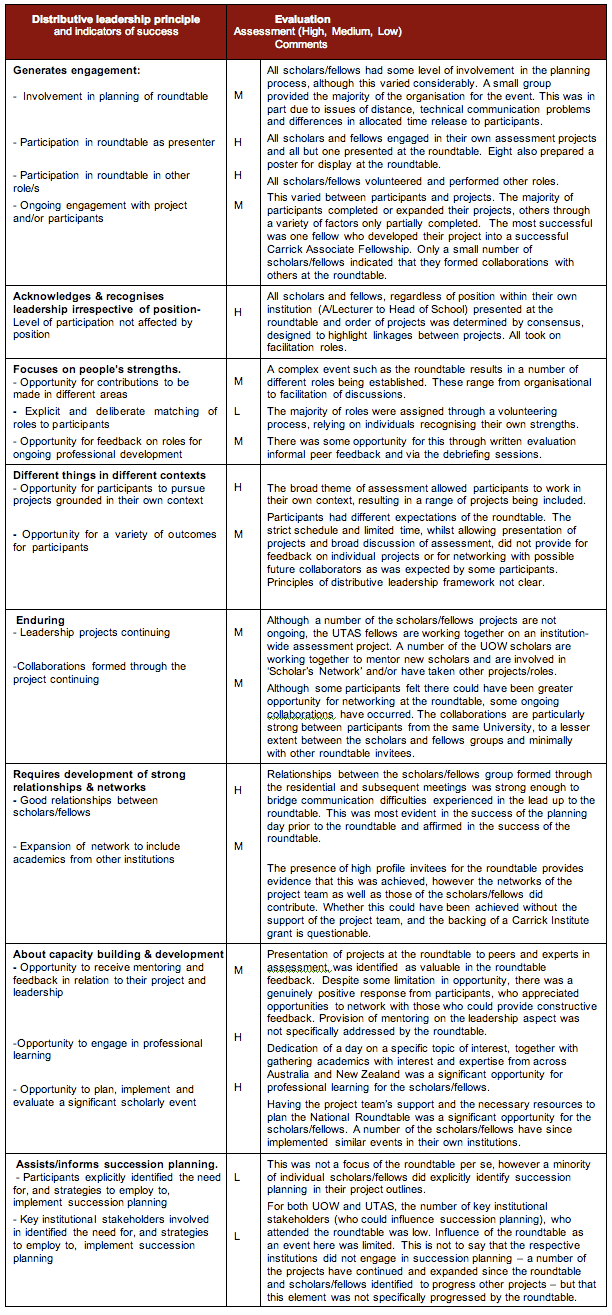
In order to position the findings of this study in the broader frame of distributive leadership, a framework for evaluation of the roundtable project has been developed by the authors based on the principles developed by the scholars, fellows and project team referred to on page 4 of this paper and outlined by Lefoe, Smigiel & Parrish (2007, p. 5). The table below sets out those principles on the left together with indicators of success in meeting those principles developed by the authors. On the right, the table evaluates the level of success in relation to those indicators and offers comments based on the data collected.
Table 5 Evaluation of Roundtable project against distributive leadership principles
Conclusion
The feedback data collected from participants in the roundtable conference and the reflections on the process, implementation and outcomes of the roundtable project collected from the scholars and fellows suggest that the model used for the Leadership Project, with its distributive leadership framework has had a number of positive outcomes. It has assisted most of the scholars and fellows involved in completing or progressing their projects and, at the same time, opened up possibilities for collaboration both at an institutional and cross institutional level (although the data suggests it was less successful in relation to the latter). It has led a number of the scholars and fellows to be regarded (and regard themselves) as leaders in teaching and learning in their departments or faculties and to their involvement in further important projects in their institutions. As an event, the roundtable conference was generally well received by participants and could therefore also be said to have made a positive contribution to the current debate on assessment.
When analysed against the principles of distributive leadership developed by the group early on in the project, the data collected by the authors above indicates a varied level of alignment between those principles and the practical and longer term outcomes of the roundtable project. On the whole, however, that alignment is also largely positive, with opportunities to develop and demonstrate distributive leadership available to the group.
Overall, the information gathered suggests that the answer to each of the research questions earlier posed by the authors is a guarded "yes". The model adopted for the roundtable project is useful and has the potential to make a valuable contribution to the scholarship of teaching and learning. However, the model is clearly not without its limitations both in terms of practical issues and the theoretical framework behind the model. Just as various commentators have identified a lack of certainty in the definition of the concept of distributive leadership, a number of participants in the roundtable project had difficulty in coming to a clear understanding of the concept and how to use it. It was not clear for some of the scholars as to whether the distributive leadership framework provided them with any real practical assistance in furthering their projects. Furthermore, others reported limited usefulness of the concept at a departmental or faculty level due to the leadership structure they worked within4. The authors nonetheless submit that the information gathered through the roundtable project and the wider Leadership Project and the experience of the participants has made and will continue to make a useful contribution to the study and understanding of distributive leadership and its application to the scholarship of learning and teaching in higher education.
Acknowledgements
The authors wish to acknowledge the UOW Faculty Scholars, the UTAS Assessment Fellows, the Project Coordinator, Dr Geraldine Lefoe, the Project Manager, Ms Dominique Parrish, project steering committees and other participants. We would also like to acknowledge the support provided from the Carrick Institute for Learning and Teaching in Higher Education.
References
Albon, R. (2003). 'Assessment drives the learning: Raising the bar', paper presented to the Evaluations and Assessment Conference, Adelaide, Australia, accessed 23/2/08, http://www.unisa.edu.au/evaluations/program.htm
Bennett, N.; Wise, C.; Woods, P. & Harvey, J. (2003). 'Distributed Leadership. A review of the literature' in Report for the National College of School Leadership, Nottingham, England
Boud, D. (2007). 'Great designs: what should assessment do?' paper presented at Re-engineering Assessment Practices (REAP) conference, Glasgow, Scotland, accessed 18/7/07, http://www.reap.ac.uk/reap07/ConferenceSessions/Keynotese...
Creswell, J.W. (2003). Research design: qualitative, quantitative, and mixed methods approaches. Thousand Oaks, CA: SAGE Gronn, P. (2002). 'Distributive Leadership as a Unit of Analysis', The Leadership Quarterly vol. 13, p. 423–451
Gronn, P. (2003). The New Work of Educational Leaders: Changing Leadership Practice in an Era of School Reform, Paul Chapman, London; Thousand Oaks, CA, SAGE
Jenkins, A.; Breen, R. & Lindsay, R. (2003). Reshaping teaching in higher education. Staff and Educational Development Association, Birmingham
Kreber, C. (2007). 'What's it really all about? The Scholarship of Teaching and Learning as an Authentic Practice', International Journal for the Scholarship of Teaching and Learning, vol 1, no.1, accessed 20/4/08 http://academics.georgiasouthern.edu/ijsotl/v1n1/essays/kreber/IJ_Kreber.pdf
Lefoe, G.; Smigiel, H. & Parrish, D. (2007). 'Enhancing higher education through leadership capacity development: Progressing the faculty scholars model', in Enhancing Higher Education, Theory and Scholarship, Proceedings of the 30th HERDSA Annual Conference [CD-ROM], Adelaide, 8-11 July 2007
Marshall, S.J. (2006). 'Issues in the Development of Leadership for Learning and Teaching in Higher Education', Occasional paper, Carrick Institute for Learning and Teaching in Higher Education, accessed 22/2/08, http://admin.carrickinstitute.edu.au/dspace/handle/10096/221
Miles, M.B. & Huberman, A.M. (1994). Qualitative data analysis: an expanded sourcebook. Thousand Oaks, CA: SAGE
Nicol, D. (2007). 'Principles of good assessment and feedback: theory and practice', paper presented at Re-engineering Assessment Practices (REAP) conference, Glasgow, Scotland, accessed 18/7/07, http://www.reap.ac.uk/reap07/Portals/2/CSL/keyn...
Patton, M.O. (1990). Qualitative research and Evaluation Methods. Newbury Par, CA: Sage
Ramsden, P. (1992). Learning to teach in higher education. London: Routledge
Sogurno, O.A. (2002). 'Selecting a quantitative or qualitative research methodology: An experience', Education Research Quarterly, vol.26, no. 1, p. 3-10
Spillane, J. (2006). Distributed Leadership, Jossey- Bass, San Francisco
Stake, R.E. (1995). The art of case study research. Thousand Oaks, CA: SAGE
Tight, M. (2003). Researching Higher Education. Society for Research in Higher Education, Open University Press, England
Trigwell, K.; Martin, E.; Benjamin, J. & Prosser, M. (2000). 'Scholarship of teaching: A model', Higher Education Research & Development, vol.19, no. 2, p. 155-168, accessed 2/5/08, http://www.clt.uts.edu.au/Scholarship/A.Model.html
West-Burnham, J. (2004). Building leadership capacity – helping leaders learn: An NCSL thinkpiece. Retrieved 20/2/2008 at http://www.ncsl.org.uk/media/F7B/92/randd-building-lead-capacity.pdf
Whitby, G. (2006). Distributive leadership as an emerging concept, Australian Centre for Educational Leadership. Retrieved 22/2/08 at http://www.uow.edu.au/educ/research/CEL/whatsnew/files/WHITBY_Article_Jun_26_06.pdf
Yin, R.K. (2003). Case study research: design and methods, Thousand Oaks, CA: SAGE
Zepke, N. (2007). 'Leadership, power and activity systems in a higher education context: will distributive leadership serve in an accountability driven world?', International Journal of Leadership in Education, vol. 10, no. 3, p. 301–314.
Footnotes
1 With the change of Federal government in late 2007, it was announced that the RQF would not proceed. The impact of this development on research on the scholarship of teaching remains to be seen but the level of interest in this area at an institutional, cross-institutional and international level suggests that the scholarship of teaching will remain a priority for universities.
2 The authors of the paper to which this reference relates, namely Geraldine Lefoe, Heather Smigiel and Dominique Parrish, were also members of the project team. In the cited paper, Lefoe, Smigiel and Parrish detail the background to the project and the project objectives. The paper was delivered at a conference in July, 2007 and reports on progress of the project to that date.
3 The term 'roundtable' in the context of conferences has no fixed definition but usually refers to a format that invites direct input and active involvement of the invitees or participants rather than a more traditional conference format largely centred on paper-based presentations delivered to attendees. Whilst there may be selected presentations or a keynote speaker at a roundtable, this is done in an interactive way with issues raised discussed by the group. The participants have a direct bearing on the outcomes.
4 Zepke's (2007) case study of distributive leadership in the context of a higher education institution in New Zealand contains positive but also guarded messages about the role of distributive leadership in that context and highlights the issues that arise when a distributive leadership framework collides with a hierarchical accountability or "audit" culture.